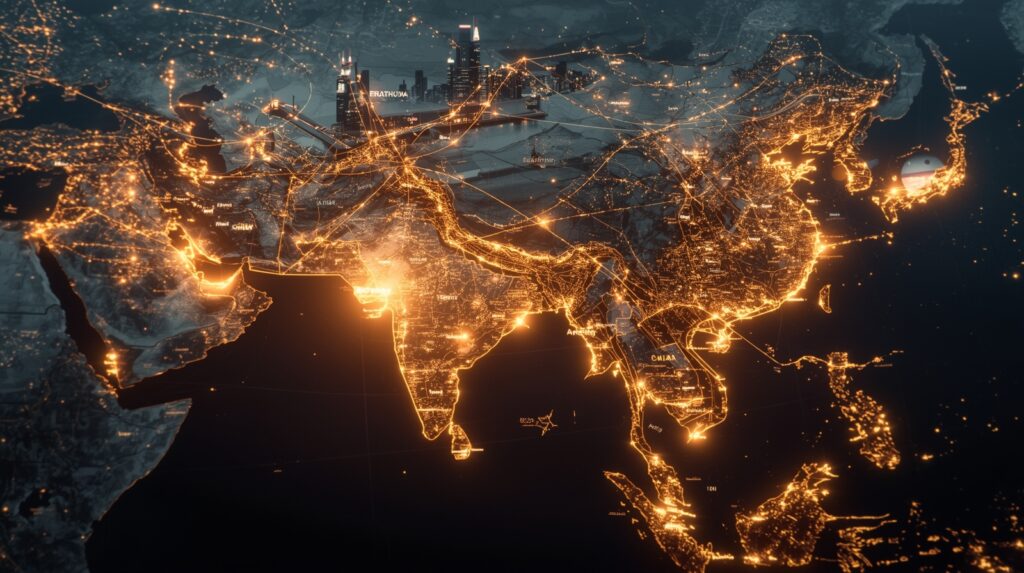

Global economic influence is shifting toward Asia. The combined growth of ASEAN, China, and India is creating a structural transformation in trade, production, and investment. This development marks what analysts describe as the New Asian Century — a period in which Asian economies play a defining role in shaping global output, innovation, and policy.
The growth trajectory of these economies is not limited to GDP expansion. It involves deeper integration through regional trade, digital connectivity, and demographic advantages. This article explores how ASEAN, China, and India are reshaping global economics through production, trade, technology, and institutional cooperation.
2. The Background: From Industrial West to Productive Asia
- Historical Overview
- After World War II, industrial production was concentrated in North America and Western Europe.
- By the 1980s, Japan and the Asian Tigers emerged as manufacturing centers.
- The 21st century marks a broader shift with China, India, and ASEAN becoming central players.
- Structural Drivers
- Economic reforms, demographic expansion, and digital transformation accelerated growth.
- Global supply chains relocated to Asia to benefit from competitive markets and infrastructure.
- Changing Balance of Power
- The share of global GDP held by Asian economies continues to rise, reducing dependence on Western demand.
3. China’s Economic Transformation
- Manufacturing and Supply Chains
- China remains the leading manufacturing hub, producing goods from electronics to machinery.
- Industrial clusters support global exports while moving up the technological value chain.
- Trade and Infrastructure Initiatives
- The Belt and Road Initiative connects Asia, Africa, and Europe through transport and energy networks.
- Chinese logistics companies now anchor major global supply routes.
- Technology and Innovation
- Investment in digital industries supports local platforms and global competitiveness.
- Domestic consumption growth sustains internal market expansion.
- Currency and Finance
- The yuan is increasingly used in trade settlements.
- China promotes financial connectivity through multilateral development banks and currency swaps.
China’s transformation positions it as a central node in global production and finance.
4. India’s Economic Growth and Global Role
- Reform and Expansion
- India’s market reforms support large-scale industrial and service-sector growth.
- The country’s digital infrastructure enables scalable business operations.
- Demographic Advantage
- A young workforce supports manufacturing, IT, and startup ecosystems.
- Expanding education and skill training sustain long-term productivity.
- Technology and Services
- India leads in IT outsourcing, software development, and fintech adoption.
- Digital payment systems strengthen domestic and cross-border financial inclusion.
- Regional and Global Engagement
- India enhances trade ties with ASEAN, Japan, and Africa.
- Participation in supply chain resilience initiatives diversifies global production.
India’s structural shift strengthens its position as a major economic and technological partner across regions.
5. ASEAN’s Collective Power
- Economic Integration
- The Association of Southeast Asian Nations functions as a unified market through the ASEAN Economic Community.
- Regional trade and investment frameworks encourage industrial collaboration.
- Strategic Geography
- ASEAN economies occupy a key position linking East Asia, South Asia, and the Pacific.
- Maritime and digital trade routes pass through ASEAN hubs such as Singapore, Malaysia, and Vietnam.
- Trade Agreements
- ASEAN plays a leading role in the Regional Comprehensive Economic Partnership (RCEP).
- Integration with China, Japan, and Korea reinforces Asia-wide trade networks.
- Diverse Economic Strengths
- Members specialize in manufacturing, agriculture, energy, and services.
- Combined, ASEAN represents one of the world’s largest consumer markets.
ASEAN’s cohesion enhances Asia’s overall global influence.
6. The Role of Regional Integration
- Trade Agreements
- RCEP unites 15 Asia-Pacific economies into the world’s largest trading bloc.
- The agreement standardizes tariffs and rules of origin across the region.
- Infrastructure Connectivity
- Projects such as the Trans-Asian Railway and digital corridors link markets.
- Cross-border investments improve logistics and energy networks.
- Institutional Cooperation
- Regional organizations coordinate financial stability, innovation, and disaster management.
Integration strengthens Asia’s ability to manage economic cycles collectively.
7. Shifts in Global Supply Chains
- Diversification
- Firms relocate production from single-country dependence toward multi-country networks.
- China, India, and ASEAN each occupy unique roles in electronics, textiles, and machinery.
- Resilience Strategies
- Regional supply networks reduce vulnerability to global disruptions.
- Investment in automation and local manufacturing increases efficiency.
- Export Orientation
- Asia remains the primary exporter of manufactured goods to global markets.
- Regional intra-Asian trade continues to expand faster than trade with Western economies.
These shifts reinforce Asia’s centrality in global production systems.
8. Digital Economy and Innovation Hubs
- E-Commerce and Fintech
- China leads global digital retail; India and ASEAN drive fintech adoption.
- Digital wallets, online banking, and logistics technologies reshape trade operations.
- Startups and Innovation
- Major cities such as Shenzhen, Bengaluru, and Singapore serve as innovation centers.
- Government support for research and technology accelerates productivity.
- Data and Connectivity
- Fiber networks and satellite systems expand digital access.
- Cloud computing and AI applications improve efficiency in services and logistics.
The digital transformation anchors Asia’s next phase of economic expansion.
9. Energy and Sustainability
- Renewable Energy Transition
- Investment in solar, hydro, and wind projects rises across the region.
- Policies encourage cleaner industrial production and electric mobility.
- Energy Security
- Asia diversifies energy imports from the Middle East, Africa, and Russia.
- Cross-border pipelines and power grids enhance regional cooperation.
- Green Finance
- New financial instruments fund sustainable infrastructure and energy transition.
Sustainability initiatives align with global economic adaptation goals.
10. Financial and Monetary Cooperation
- Regional Payment Systems
- Local currency settlements increase in ASEAN, China, and India trade.
- Digital banking integration reduces transaction costs.
- Multilateral Development Financing
- The Asian Infrastructure Investment Bank and New Development Bank provide project funding.
- Collaboration focuses on transport, renewable energy, and connectivity.
- Investment Trends
- Sovereign funds and private capital flow toward intra-Asian ventures.
These measures support long-term regional financial independence.
11. Asia’s Role in Global Governance
- Representation in International Institutions
- Asian countries seek balanced participation in global organizations such as the IMF and WTO.
- New Frameworks
- Asian-led institutions offer alternative platforms for dialogue and cooperation.
- Global Development Initiatives
- Asia contributes to infrastructure and climate programs in developing regions.
Asia’s institutional engagement complements its economic influence.
12. Labor Markets and Human Capital
- Demographic Trends
- India and several ASEAN states have expanding working-age populations.
- China focuses on automation as its population stabilizes.
- Education and Skills
- Investment in science, engineering, and technology education improves productivity.
- Migration and Workforce Mobility
- Cross-border labor movement within Asia supports industrial and service growth.
Human capital development ensures sustainable competitiveness.
13. Trade with the Rest of the World
- Exports to the West
- Asia continues to supply consumer goods, electronics, and machinery to Western markets.
- South-South Trade
- Partnerships with Africa, the Middle East, and Latin America expand.
- Investment Outflows
- Asian firms invest globally in logistics, manufacturing, and energy.
Asia’s outward engagement reinforces its global role.
14. Challenges and Strategic Adjustments
- Economic Balancing
- Managing growth while avoiding overdependence on exports remains a key objective.
- Geopolitical Tensions
- Regional disputes and global competition create coordination challenges.
- Technological Competition
- Access to semiconductors and advanced manufacturing remains a constraint.
- Climate and Resource Management
- Rapid industrialization demands sustainable energy and water use.
These challenges define the next phase of economic transformation.
15. Future Outlook: The Structure of the New Asian Century
- Regional Economic Leadership
- China, India, and ASEAN are expected to account for more than half of global growth.
- Technology and Innovation Networks
- Regional cooperation in AI, digital trade, and clean technology will expand.
- Institutional Maturity
- Asian financial and development institutions will strengthen influence.
- Global Partnerships
- Asia’s engagement with Africa, Europe, and Latin America will balance the global economy.
The New Asian Century represents not a single-country dominance but a collective regional advancement shaping a balanced world economy.
The rise of ASEAN, China, and India is redefining the structure of global economics. Regional cooperation, technological development, and demographic advantage create an ecosystem of interconnected growth.
The transformation signals a global economy less dependent on any single region. Instead, interdependence and shared leadership define the new era. The New Asian Century reflects a long-term shift in which Asia’s integration and innovation determine global economic stability and direction.